
Beyond Roads: How Chhattisgarh’s Gramin Bus Yojana Is Bringing Education, Healthcare and Jobs Within Reach
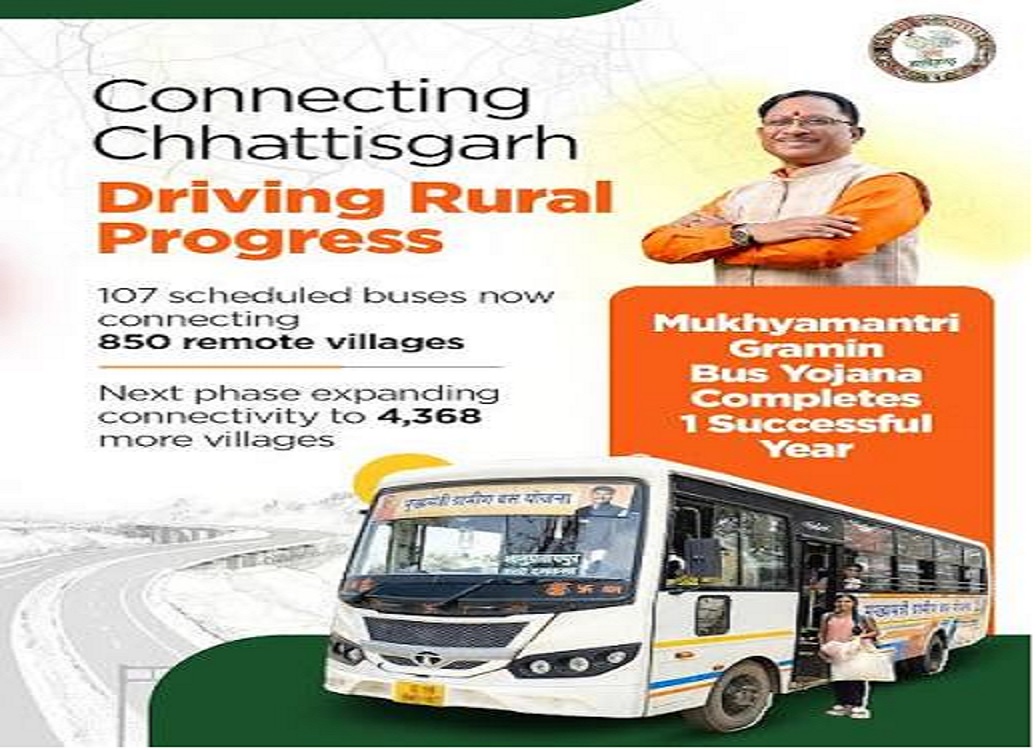
With 107 buses operating across 106 routes in 13 districts, the Mukhyamantri Gramin Bus Yojana is opening new avenues for tribal communities. The initiative, guided by IAS officer S. Prakash, combines private participation, government support and technology-driven monitoring to improve rural connectivity.
In remote parts of Chhattisgarh, reaching a school, hospital or local marketplace has not always been a straightforward journey. For many tribal families, geographical isolation, difficult terrain and limited public transport have made even routine travel expensive and uncertain.
A student trying to attend classes, a patient seeking medical attention or a farmer carrying produce to market could face the same basic obstacle: finding an affordable and dependable vehicle.
The Mukhyamantri Gramin Bus Yojana is attempting to change that reality. By extending scheduled bus services to underserved rural areas, the Chhattisgarh government is seeking to connect isolated settlements with essential public services and economic opportunities.
At the centre of the initiative is IAS officer S. Prakash, a 2005-batch officer of the Chhattisgarh cadre who serves as Secretary and Commissioner of the state’s Transport Department.
The scheme began with 34 buses serving approximately 250 villages. By October 2026, the network had expanded to 107 buses operating on 106 routes across 13 districts in the Bastar and Surguja divisions.
Its significance goes beyond the number of buses on the road. The programme is designed to address a longstanding development challenge: how to provide regular public transport in places where commercial operators have traditionally struggled to make their services financially viable.

A Longstanding Transport Gap in Rural Chhattisgarh
When Chhattisgarh became a separate state on November 1, 2000, it inherited a government-operated transport system. However, difficult operating conditions, limited passenger demand and repeated attacks on buses during the years of Naxalite violence created serious challenges for the network.
By 2006, government-run bus services had been discontinued, leaving several remote communities with few reliable transport options.
Residents increasingly depended on privately available vehicles, including pickup trucks and goods carriers, to reach nearby towns. Such arrangements could involve higher fares, uncertain departure times and limited seating. For families living far from administrative centres, the consequences extended into everyday life.
Students could struggle to reach schools and colleges regularly. Patients might find travelling to hospitals difficult, while farmers and small traders faced additional expenses when transporting agricultural produce or travelling to local markets.
The absence of reliable public transport also limited access to government offices and other services concentrated in towns. The challenge was therefore not simply about mobility. It was about whether people living in geographically isolated areas could access opportunities available to residents of better-connected locations.
The Mukhyamantri Gramin Bus Yojana was introduced to address this gap. Union Home Minister Amit Shah inaugurated the programme at Jagdalpur on October 4, 2025, in the presence of Chief Minister Vishnu Deo Sai.
The initial rollout covered 34 routes and connected around 250 villages. Its subsequent expansion has sought to bring more rural settlements into the regular public transport network.
An Alternative to a Fully Government-Operated Fleet
One of the defining features of the programme is its operating structure.
Instead of creating an entirely new government-owned bus fleet for the scheme, the state has chosen to work with private bus operators. This allows existing private-sector capacity to be used for public transport services on designated rural routes.
Under the arrangement, operators own their buses, manage day-to-day expenses and collect fares from passengers. Government assistance helps compensate for the financial gap on routes where passenger revenue alone may not cover operating costs.
The model recognises a basic economic difficulty. A bus service can be socially essential even when it is not immediately profitable.
Remote villages often have dispersed populations and relatively low passenger volumes. For a private operator, running a bus regularly under such circumstances can be commercially unattractive, particularly when fuel, maintenance and other operating expenses must be met.
Without financial support, services may remain concentrated on routes with stronger passenger demand, leaving less profitable communities underserved.
The scheme attempts to bridge that gap by making rural routes more feasible for private operators while extending transport access to residents.
According to the figures reported for the programme, 107 buses are operating on 106 routes across 13 districts. The notified network covers approximately 5,300 kilometres, with individual routes ranging from 14 to 105 kilometres.
Most routes have two scheduled trips daily, generally during the morning and evening. These services connect villages with nearby block, tehsil and district headquarters.
The expansion has particular relevance for districts such as Sukma, Bijapur, Dantewada and Narayanpur, where difficult geography and historically limited connectivity have complicated access to public services.
How Government Assistance Supports Rural Routes
The financial mechanism behind the programme is known as viability gap funding.
Under this arrangement, the government provides financial assistance to help operators maintain services on routes where passenger fares may not be sufficient to meet operational expenses.
The reported ceiling for assistance is Rs 26 per kilometre during the first year, Rs 24 per kilometre in the second year and Rs 22 per kilometre in the third year, subject to the applicable bidding and payment conditions.
Operators are also exempt from monthly motor vehicle tax for up to three years under the scheme.
The support structure is intended to make it easier for private operators to begin services in areas where demand may take time to develop.
The government’s approach also seeks to link public expenditure with actual bus operations rather than relying entirely on the claims submitted by operators.
Buses are equipped with vehicle location tracking devices. The Transport Department can use this information through its control and command system to monitor movement along designated routes.
Operators submit subsidy claims through the Mukhyamantri Gramin Bus Yojana portal. These claims are checked against vehicle-tracking information before payments are processed.
According to the reported government figures, financial assistance amounting to Rs 5.77 crore was disbursed during the scheme’s first year.
Technology-based verification provides an additional layer of oversight. It helps authorities assess whether subsidised services are operating on their approved routes and whether payments correspond with actual distance travelled.
The gradual reduction in subsidy ceilings is also intended to encourage routes to become more commercially sustainable as passenger numbers increase.
Lower Travel Costs Offer Immediate Relief
The programme’s practical value can be understood through the difference between the cost of an uncertain private journey and that of a scheduled bus service.
On the Konta–Jagargunda route in Sukma district, which stretches approximately 83 kilometres, the Transport Department’s assessment indicates that a journey that previously cost around Rs 200 or more in a pickup vehicle can now be made for approximately Rs 130 by bus.
For shorter journeys between villages, where an available vehicle could cost around Rs 200, the bus fare can be approximately Rs 50.
Such differences can matter considerably to rural households that must manage education, healthcare, food and other daily expenses on limited incomes.
Affordable fares are only one part of the improvement. Regular departure times and assured seating can make journeys more predictable and convenient.
This is particularly relevant for women, children, older residents and patients, for whom travelling in goods carriers may be uncomfortable or potentially unsafe.
Scheduled transport can also help residents plan their day more efficiently. Instead of searching for a vehicle whenever they need to travel, passengers have a service with established timings and routes.
According to the programme’s reported first-year figures, the network has extended to 850 villages that previously lacked regular passenger transport. Buses have collectively covered approximately 24 lakh kilometres.
These figures provide an indication of the programme’s reach, although its longer-term success will also depend on the reliability and quality of services experienced by passengers.
Education: Connecting Students With Greater Opportunities
For students in remote tribal villages, transport can influence educational choices and attendance.
A school may be located several kilometres away, while higher secondary institutions and colleges are often situated in towns. Without dependable transport, students can face long walks, irregular travel arrangements and additional expenses.
A scheduled bus service offers a more predictable option for reaching educational institutions.
For families, this can reduce the logistical difficulties associated with sending children to school. It can also make it easier for students to explore higher education opportunities in nearby urban centres.
Reliable transport is particularly important when educational institutions are beyond walking distance or when students must coordinate their travel with fixed class timings.
The benefits are not limited to the journey itself. Better connectivity can help reduce the geographical disadvantages faced by students from isolated settlements.
However, the extent of the educational impact will depend on whether bus timings align with school and college schedules, whether fares remain affordable and whether services operate consistently throughout the year.
The scheme’s emphasis on connecting rural settlements with administrative and urban centres provides a foundation for improving these links.
Better Access to Hospitals and Public Services
Healthcare is another area where regular transport can make a tangible difference.
Residents of remote villages may need to travel to towns for medical consultations, diagnostic tests, medicines or follow-up treatment. When transport is uncertain, even a routine hospital visit can become complicated.
A dependable bus service gives passengers a more predictable way to reach medical facilities.
It may also help families plan journeys in advance rather than depending on the availability of a private vehicle at the last moment.
The scheme is not a replacement for emergency ambulance services, and scheduled buses cannot meet every urgent medical need. Nevertheless, improved routine connectivity can make healthcare facilities more accessible for consultations and planned treatment.
The same principle applies to government offices and other public institutions.
When administrative services are located outside a village, the time and cost of reaching them can influence how easily residents access entitlements, complete official work or seek assistance.
By connecting villages with block, tehsil and district headquarters, the rural bus network can help reduce some of these practical barriers.
Supporting Farmers, Traders and Rural Employment
The economic implications of transport connectivity extend beyond passenger movement.
Farmers often need to reach markets to sell produce, purchase agricultural inputs or access services. Small traders may depend on regular travel to obtain supplies and conduct business.
When transport is expensive or unpredictable, these activities become more difficult to organise.
Affordable bus services can make travel to nearby markets more manageable. They may also help rural residents reach towns where employment opportunities, commercial establishments and other sources of income are available.
For people seeking work, the ability to travel at predictable times can expand the range of opportunities they can realistically consider.
Better transport may also support the movement of people between villages and local economic centres, encouraging greater participation in markets and services.
The overall impact will vary from route to route. Passenger demand, travel frequency, market access and the location of employment centres will influence how much individual communities benefit.
Even so, the scheme addresses an important prerequisite for rural economic participation: the ability to reach places where opportunities exist.
Expanding the Network While Protecting Its Viability
The expansion from 34 buses to 107 buses indicates that the programme has moved beyond its initial rollout. Sustaining this growth, however, will require continued attention to service quality and financial performance.
According to the reported figures, 31 of the 107 buses have occupancy levels exceeding 60 per cent. Officials have also indicated that some operators have begun covering additional kilometres without financial assistance, suggesting that passenger demand may be strengthening on certain routes.
These developments could be encouraging signs for the programme’s long-term sustainability.
Nevertheless, occupancy levels and additional operations on selected routes do not automatically establish that every route is commercially viable.
Passenger demand can fluctuate with seasons, local economic activity and travel requirements. Fuel prices, maintenance expenses, vehicle availability and fare collections will also affect operators’ ability to continue services.
The government must therefore balance two objectives: reducing the financial burden of the programme over time and ensuring that remote communities do not lose access to essential transport.
A rapid withdrawal of assistance from routes with limited passenger demand could undermine the very purpose for which the scheme was introduced.
At the same time, continued monitoring can help identify routes where demand is growing, where schedules need adjustment and where operating arrangements may require improvement.
Careful planning will be essential to maintain a dependable network while using public funds effectively.
The Role of Administration in Delivering Public Policy
The rural bus initiative highlights an important aspect of public administration: a policy’s success depends not only on its announcement but also on the mechanisms through which it reaches people.
In this case, the approach combines private operators, targeted financial support, designated routes and technology-based monitoring.
Each element addresses a different implementation challenge.
Private participation provides an operating network without requiring the government to establish an entirely new fleet. Financial assistance helps make difficult routes more attractive to operators. Vehicle tracking supports verification, while scheduled services provide a more structured transport option for passengers.
For IAS officer S. Prakash and the Transport Department, the larger task is to ensure that the expanding network translates into dependable services for the communities it is intended to serve.
The programme’s performance will ultimately depend on consistent implementation, effective supervision and the ability to respond to local transport requirements.
Its wider relevance lies in the effort to make public transport available in places where a conventional market-driven model may not provide adequate coverage.
From Connectivity to Inclusive Development
Chhattisgarh’s remote tribal regions have faced barriers shaped by difficult terrain, inadequate infrastructure and years of conflict. Improving security and peace is an important step towards development, but it does not automatically resolve the everyday disadvantages created by isolation.
Communities also need roads, transport, educational facilities, healthcare access and opportunities to earn a livelihood.
The Mukhyamantri Gramin Bus Yojana seeks to address one part of this wider challenge by making regular passenger services available to villages that have historically lacked dependable connections.
Its expansion across 13 districts demonstrates the scale of the effort, while its public-private operating model offers a way to extend services without establishing a completely new government transport system.
The programme’s achievements should be judged not only by the number of buses deployed, routes notified or kilometres covered, but also by whether passengers can depend on the service when they need it.
For a student, success may mean reaching school or college more regularly. For a patient, it may mean having a more reliable way to reach a hospital. For a farmer or small trader, it may mean travelling to market at a lower cost.
These are everyday outcomes, but their combined effect can be significant.
By improving access to essential services and economic centres, the rural bus network has the potential to help turn geographical connectivity into wider social and economic participation.
For Chhattisgarh, the next test will be to sustain the expansion, maintain affordable fares and ensure that the benefits reach the communities most dependent on public transport.
If those objectives are achieved, the scheme could become an important example of how targeted public support and practical administrative planning can help bridge the distance between remote villages and the opportunities beyond them.


